
TL;DR
Choose a Thanksgiving roasting pan by checking its interior dimensions against both your turkey and oven, then compare material, depth, rack, and stovetop rating. A sturdy pan that fits your cooking plans matters more than a bundle of accessories, and a disposable pan needs a rigid tray underneath for support.
The turkey can fit in the pan and still fail the oven test: the door may not close, a rack may not slide out, or the loaded pan may flex when you lift it. Fit, strength, and safe handling matter before the bird ever reaches the table.

Get kitchen staples and gadgets delivered free with Prime
- Fast, free delivery on millions of items
- Prime Video, Amazon Music and more included
- Member-only deals all year
A roasting pan is a wide, sturdy pan designed to hold a large roast and catch its juices. For Thanksgiving, that usually means turkey, though the same pan can roast vegetables, chicken, or beef and help you make gravy.
This guide walks you through sizing a pan to your turkey and oven, choosing a material and rack, and checking whether the pan can go on the stovetop. You’ll also get practical ways to handle a heavy roast and clean stubborn drippings without damaging the finish.
Measure both the oven interior and roasting pan interior before choosing a size.
Choose a sturdy pan that leaves clearance around the turkey; avoid crowding it with deep sides.
Check the manufacturer’s oven temperature, stovetop, broiler, and cleaning guidance.
A rack helps raise the turkey above drippings, but a vegetable bed can work as a simple alternative.
Support disposable aluminum pans with a rigid baking sheet or tray before loading a turkey.
Measure your turkey and oven before choosing a pan
A Thanksgiving roasting pan should hold your turkey with some clearance around it and still fit inside your oven with the door closed. Check the pan’s interior dimensions, then compare them with the bird and the available space between your oven racks and walls. No single pan size suits every turkey or oven.
Think of the pan and oven like a suitcase and an overhead bin: the label size tells only part of the story. A bird may sit comfortably in a pan on the counter, yet the handles can prevent the oven door from shutting. Measure the oven interior, account for the rack position, and leave room to slide the rack out safely.
For example, if you’re buying a pan before Thanksgiving, place a tape measure inside your oven and note the width, depth, and height available where the pan will sit. Then check the pan’s inside dimensions rather than relying on a product’s outside measurements. This small check can save you from discovering, with a thawing turkey waiting nearby, that the handles hit the oven walls.
Also consider how much room the roast needs to sit securely without touching the sides. A cramped bird is harder to handle, while an oversized pan can be awkward to move and store. Choose the smallest pan that comfortably fits the turkey and leaves the oven enough clearance.
Products Worth Considering

De'Longhi La Specialista Arte Evo Semi-Automatic Espresso Machine with Grinder and Cold Brew

Cuisinart Precision Pro 5.5-Quart Digital Stand Mixer, Graphite

KitchenAid 5.5-Quart Bowl-Lift Stand Mixer, Porcelain White
As an affiliate, we earn on qualifying purchases.
Pick a material that matches your cooking and cleanup
Stainless steel, aluminum, enameled steel, and nonstick each bring a different balance of durability, heat response, and cleanup. For many cooks, stainless steel is a versatile choice, especially if the manufacturer allows stovetop use for gravy. Nonstick can release food easily, but its heat limits and coating life deserve a close look.
Aluminum heats quickly, which can help a pan respond fast to oven heat, but it may react with acidic ingredients unless coated. Enameled steel is easy to clean, though a chipped coating can change how the pan performs and should prompt you to follow the maker’s care guidance. A heavy-gauge pan is generally less likely to warp under a heavy bird or high heat than a very thin one.
Imagine roasting a turkey with lemon and herbs, then setting the pan over a burner to loosen browned bits. You’ll want to know whether the material and manufacturer instructions permit that use. If the pan isn’t approved for direct heat, pour the drippings into a saucepan instead; a transfer takes little time and protects the cookware.
Product descriptions may feature induction bases, reinforced construction, or easy-clean finishes. Treat each as a claim to verify in the specific pan’s instructions. “Induction compatible” refers to the suitable base and does not automatically mean every part of a large pan will heat well on every cooktop.
Choose a rack and depth that help the bird roast evenly
A rack raises the turkey above the pan’s drippings, giving hot air more room to move around the bird and making juices easier to collect. A rack is helpful, but it isn’t essential: a bed of vegetables can lift the turkey too. The choice depends on whether you want more airflow, space for vegetables, or a simple setup.
A V-shaped rack supports the bird’s shape, while a flat rack leaves more room around it for carrots, onions, or potatoes. For instance, if your family expects roasted vegetables alongside the turkey, a flat rack may leave a useful ring of space. If you plan to roast the vegetables separately, a V-shaped rack can cradle the bird instead.
Depth matters as well. The sides need to be high enough to contain drippings, but very deep sides can impede airflow around the turkey. That can make browning less even, while sides that are too low risk splashes and leave less room to collect juices for gravy. Rounded corners can make it easier to stir pan juices and pour them into a gravy separator or saucepan. Aim for sides that catch the drippings without crowding the bird; the pan should feel like a catch basin, not a tall fortress surrounding it.
If the pan includes a rack, check whether it is oven safe at your intended cooking temperature and whether it fits the pan securely. Follow a reliable recipe for cooking time and temperature, and use a food thermometer to check that the turkey reaches a safe internal temperature. A rack changes how the bird sits and how juices collect; it does not guarantee even cooking or replace temperature checks.
Use this quick checklist before you buy
Before buying Thanksgiving roasting pans, check the pan’s fit, weight, heat limits, stovetop rating, and cleaning instructions. Those details determine whether it works with your oven and cooking plans. You can run through this five-step check while comparing models or inspecting a pan you already own.
- Measure the oven and bird. Confirm the interior pan dimensions leave space around the turkey and fit the oven with the door closed.
- Check construction and handles. Look for a sturdy build and secure handles, then remember a full pan becomes heavy.
- Confirm heat use. Read the maximum oven temperature and whether the pan is safe on your cooktop or under the broiler.
- Inspect the rack and accessories. Verify whether a rack, lifters, or baster are included or sold separately.
- Plan cleanup and storage. Check dishwasher guidance and measure the cupboard space the pan will need.
Picture a Thanksgiving morning when the gravy plan depends on moving the pan directly to a burner. Step three tells you whether that’s safe; if the instructions don’t approve stovetop use, plan to transfer the drippings to a saucepan. That’s an easy adjustment when you know in advance, and a frustrating surprise when guests are already at the table.
For occasional cooking, prioritize a sturdy pan sized to your oven and turkey over extra tools. Sets can be handy, but included accessories only add value if you’ll use them and can store them.
Handle a full roasting pan without a Thanksgiving spill
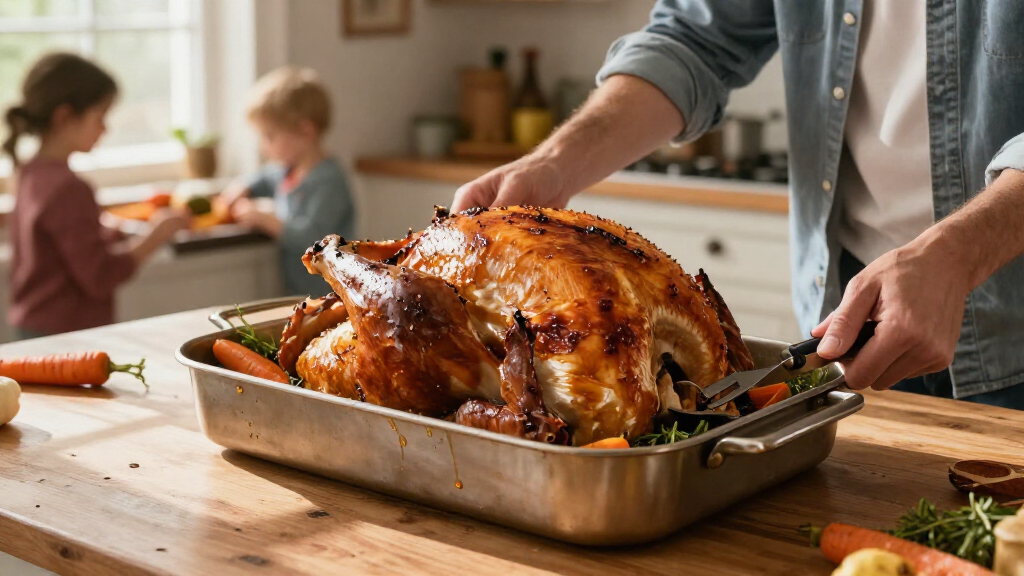
A roasting pan loaded with a large bird and hot drippings can be difficult to lift, so plan the route from oven to counter before cooking. Use two hands, secure oven mitts, and clear a stable landing spot close to the oven. The pan’s handles help, but they can also be hot and the load remains heavy.
A simple routine reduces the chance of a wobble: pull the oven rack partly out, check that your mitts are dry and in good shape, then lift the pan evenly without tilting it. If you need help, ask another adult to clear the path or guide the oven door; don’t try to carry a sloshing pan around clutter. Hot fat can burn quickly.
Disposable aluminum pans can work, but thin sides may bend under a turkey’s weight. Place the disposable pan on a rigid baking sheet or tray before adding the bird, then move the whole supported assembly. This is especially useful if you’re bringing food to another kitchen, where you may not know the oven setup.
After roasting, follow a trusted food-safety guide for how long cooked turkey can stay at room temperature and how to refrigerate leftovers. Don’t leave the bird sitting out while everyone grazes for hours. A thermometer and prompt, appropriate storage help keep the feast safe as well as delicious.
Make cleanup easier and get more use from the pan
Let a roasting pan cool before cleaning, then soak it with warm water and dish soap to soften stuck-on drippings. A nonabrasive scrubber can loosen residue without scratching many finishes, but always follow the maker’s care instructions, especially for nonstick coatings and enamel. Avoid putting a hot pan into cold water, which can stress some cookware.
For a real-world example, imagine the pan after gravy-making: dark fond clings to the corners, and fat has cooled into a slick layer. A soak loosens the mess so you can clean it without attacking the surface with a sharp tool. If residue remains, repeat the soak and use a utensil suitable for that pan’s finish.
A roasting pan can earn its cupboard space beyond Thanksgiving. Use it for a Sunday chicken, a large cut of beef, a tray of vegetables, or a casserole that needs high sides. That multi-use value can matter more than a set of lifters or a baster you may use once a year.
Storage is part of the decision too. A large pan may take up more space than you expect, particularly if its handles don’t nest inside other cookware. Measure the cupboard or shelf before buying; a pan that works beautifully in the oven but blocks your only baking-sheet shelf may not be the best fit for your kitchen.
Frequently Asked Questions
What size roasting pan do I need for a Thanksgiving turkey?
Choose a pan that holds the bird comfortably with some clearance around it, then confirm it fits your oven with the door closed. Compare interior dimensions, since outside measurements include handles and walls.
Do I need a rack to roast a turkey?
No. A rack lifts the turkey above drippings and helps air circulate, but a bed of vegetables can raise the bird too. A flat rack leaves more space for vegetables than a V-shaped one.
Can I make gravy in the roasting pan?
Only if the manufacturer says the pan is safe for stovetop use and it fits your burner. Otherwise, transfer the drippings to a saucepan and make gravy there.
Can I use a disposable aluminum pan for turkey?
Yes, but thin disposable pans can bend under a heavy turkey. Set the pan on a rigid baking sheet or tray before loading and follow the pan’s heat-use instructions.
Is stainless steel or nonstick better for a roasting pan?
Stainless steel is durable and often suits browning and stovetop gravy-making when the manufacturer approves it. Nonstick can make release and cleanup easier, but check its heat limit and care instructions because coatings can wear.
How do I clean stuck-on drippings?
Let the pan cool, soak it in warm water with dish soap, then loosen residue with a nonabrasive tool that suits its finish. Follow the manufacturer’s directions for nonstick or enamel cookware.
Conclusion
Choose your pan by measuring first, then match its construction and heat rating to the way you plan to cook. A sturdy pan that fits your bird and oven will do more for Thanksgiving than a drawer full of accessories.
On the big day, make room on the counter before the oven opens. The turkey can rest, the drippings can become gravy, and your kitchen stays calmer.