
TL;DR

Get kitchen staples and gadgets delivered free with Prime
- Fast, free delivery on millions of items
- Prime Video, Amazon Music and more included
- Member-only deals all year
A report by Casual Physics Enjoyer describes a small experiment in which chicken soaked in tartrazine solution became partly translucent, allowing a grid beneath a thin slice to show through. The result was weaker than the effect reported in a scientific paper, and the experiment was not designed to establish a safe or reliable method.
A home experiment reported by Casual Physics Enjoyer found that thin chicken breast soaked in tartrazine solution became slightly translucent, letting a grid beneath it show through. The result was limited: the author said it did not match the degree of transparency described in a research paper, and stressed that the chicken was discarded rather than eaten.
The author soaked chicken breast in solutions of tartrazine, a yellow-orange food dye found in some snack foods, including Doritos. In the reported trial, a roughly 2-millimeter-thick slice was cut from a thicker piece and soaked in an approximately 0.19-molar solution for six hours at room temperature. Under a desk light, a grid beneath the sample was faintly visible in parts of the slice. The writer described its appearance as gummy or gelatinous.
A water-soaked sample served as a control and remained opaque. A more concentrated solution, estimated at about 0.56 molar, did not produce a useful result: the author reported that dye appeared to crystallize on the chicken. In a later trial, the author soaked samples for 12 hours in covered test tubes and said the treated piece showed slight translucency compared with the water control.
The source notes that the dye powder was labeled as containing more than 80% dye, making the precise concentrations uncertain. The author also used a modified protocol rather than the conditions in the paper that inspired the test. That paper used a stronger solution, a temperature of 40°C and a shaker; the blogger said they lacked suitable equipment and a way to carry out that version safely.
A Possible Low-Cost Imaging Tool
The experiment is a small-scale demonstration of a technique that could matter for imaging biological tissue. The author said tissue transparency could make internal structures easier to observe, including for independent researchers working with relatively accessible equipment. The cited research used the approach to assist fluorescence imaging in live animals, according to the blogger’s account.
But the reported chicken test does not show that the method is ready for routine use. It involved a thin piece of raw tissue, produced only partial translucency, and did not measure how much light passed through or whether the effect was repeatable. The result is best treated as an informal replication attempt, not a validated imaging protocol or evidence that the sample is safe to handle or consume.
As an affiliate, we earn on qualifying purchases.
The Paper Behind the Kitchen Test
The blogger said a friend, Adaobi Adibe, suggested the idea and sent a paper titled “Achieving optical transparency in live animals with absorbing molecules.” In the account, the paper describes using tartrazine to make biological tissue, including chicken breast, more transparent. The post presents the home experiment as a preliminary effort to reproduce part of that work, with a more ambitious replication planned.
The author’s proposed explanation is that tartrazine’s absorption properties change the refractive index of water, bringing it closer to that of proteins and fats in tissue and reducing the scattering of light. The post describes this as a current model and says a fuller explanation may follow. The reported experiment did not independently test that mechanism.
“I got partial transparency but not to the degree of the paper.”
— Casual Physics Enjoyer
How Strong Is the Transparency Effect?
The post provides no quantitative measurement of translucency, no repeated-trial results and no independent verification. The author’s concentration estimates are approximate because the powder contained more than 80% dye, and the solution volume was also estimated. It is not clear how much the effect depended on slice thickness, soak time, lighting or other conditions.
Food safety also remains separate from the optical result. The author said the samples were discarded and mentioned the risk of Salmonella in raw chicken. The experiment does not establish that soaking makes chicken safe to eat, nor does it provide a safe handling or storage protocol. Readers should not treat the procedure as a recipe or consume treated raw chicken.
A More Controlled Replication
The author said they intended to attempt a more ambitious replication of the published method. No date, detailed protocol or results for that planned work were provided in the post. A useful next report would clarify the dye concentration, sample thickness, temperature and exposure time, and compare multiple treated samples with controls.
Until such results are available, the confirmed development is limited to the blogger’s report of slight translucency in a thin chicken slice under particular conditions. Whether the effect can be reproduced consistently, measured reliably or adapted into a practical low-cost imaging method remains open.
Key Questions
What does “making chicken transparent” mean in this report?
The chicken did not become fully clear. The author reported partial translucency in thin slices, with a grid beneath one sample faintly visible under light.
What is Dorito dust in this experiment?
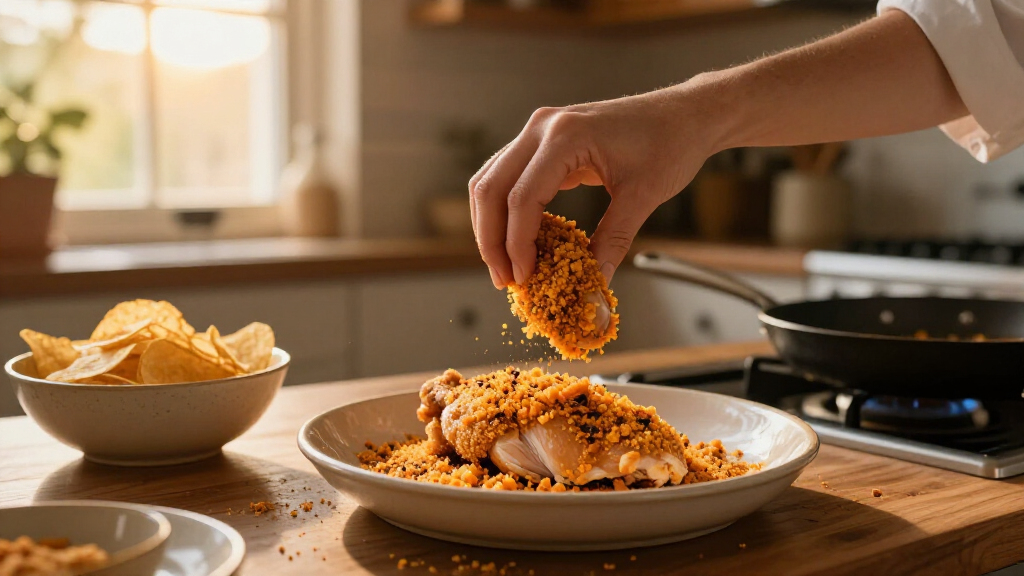
The experiment used tartrazine, a yellow-orange food dye associated with Doritos. The report does not describe using crushed snack seasoning as the treatment.
Did the result match the scientific paper?
No. The author said the home trial produced less transparency than the paper described and used different conditions, including a lower concentration and room temperature.
Is the treated chicken safe to eat?
The report does not establish that it is safe to eat. The author discarded the samples, and the experiment should not be treated as a food-preparation method. Raw chicken can carry harmful bacteria.
What happens next?
The author said a more ambitious replication was planned, but did not give a timeline or results. Repeatable measurements and clearer experimental conditions would be needed to assess the effect.
Source: hn
Halloween Picks
halloween
As an affiliate, we earn on qualifying purchases.