Choosing an electric spice grinder comes down to whether you want consistent control over grind size or a quick, affordable way to chop spices and other dry ingredients. Burr and blade models are often sold for the same kitchen task, but they work differently: a burr grinder draws spices through a set gap, while a blade grinder spins a sharp blade through the contents.

Get kitchen staples and gadgets delivered free with Prime
- Fast, free delivery on millions of items
- Prime Video, Amazon Music and more included
- Member-only deals all year

Cuisinart Spice and Nut Grinder
- ✔ Model: SG-10
- ✔ Motor power: 200 watts
- ✔ Capacity: 90 g

BLACK+DECKER One Touch Coffee and Spice Grinder, 2/3-Cup Capacity
- ✔ Model: CBG110S
- ✔ Capacity: 56.6 g (2/3 cup)
- ✔ Wattage: 130 W
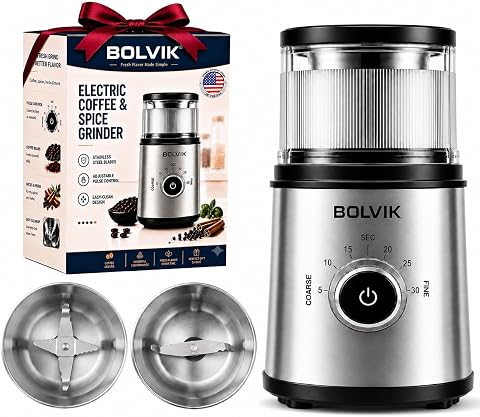
BOLVIK Electric Coffee, Spice, and Herb Grinder with Adjustable Grind Settings
- ✔ Model: BVK-BG15
- ✔ Grind settings: 6 adjustable time levels
- ✔ Coarse grind time: 5–30 seconds
A burr model is the stronger fit for cooks who grind spices often, want a more even texture, or need repeatable results for recipes. A blade model suits occasional use, simple jobs, and tighter budgets. The difference matters most with whole spices that vary in size and with recipes where a coarse or fine grind affects how flavor spreads. This comparison weighs consistency, adjustability, speed, capacity, cleanup, noise, and value so you can decide whether the extra control of burr grinding is worth paying for.
At a Glance
| Criteria | Burr electric spice grinder | Blade electric spice grinder | Winner |
|---|---|---|---|
| Grind consistency | More even particles, especially across repeated batches | More variation, with fine powder and larger pieces in one batch | A |
| Grind-size control | Usually adjustable, depending on the model | Limited; pulsing and shaking offer only rough control | A |
| Speed and ease | Can take longer and may require dialing in a setting | Fast for small batches and simple grinding | B |
| Capacity and versatility | Often designed around spices; hopper size varies | Compact models can handle spices, seeds, and other dry ingredients | Depends |
| Cleanup and flavor carryover | Nooks and burrs can hold residue; some parts may be removable | Simple chambers are often quick to wipe; blade assemblies can retain aroma | B |
| Noise and counter use | Motor noise varies; often larger and heavier | Often compact, though the spinning blade can sound sharp | B |
| Value | Costs more, with better payoff for frequent, precise grinding | Usually cheaper and practical for occasional use | Depends |
Cuisinart Spice and Nut Grinder
The Cuisinart is the clearest match for shoppers whose main task is grinding spices. Its 90 g removable bowl holds more than the BLACK+DECKER’s 56.6 g bowl, so we can handle a larger batch before stopping to refill. The bowl can also be paired with the included storage lid, which makes this setup more convenient when we want to keep a freshly ground portion close at hand.Its 200-watt motor and stainless steel blades are listed for spices and nuts, while the push-top control keeps operation simple. That simplicity is also a limitation: the supplied details do not describe adjustable grind settings or a timed cycle, unlike BOLVIK’s six time levels. We should expect to control the result through operation time rather than selecting a defined setting. The interlock requires the lid to be secured before the grinder runs, a useful safeguard that adds a small setup step.For cleanup, this model has the strongest documented case in the group: its removable bowl and lid are dishwasher-safe. That is a practical edge over BLACK+DECKER, whose cleaning details are not specified, and BOLVIK, whose bowl and blade dishwasher compatibility is unclear. Still, the bowl is not unlimited, and Cuisinart lists a 220-volt supply; we should verify that matches our kitchen’s electrical supply before buying.
Pros:
- Designed specifically for spices and nuts
- 90 g removable bowl with a storage lid
- Dishwasher-safe lid and removable bowl
- Interlock and non-slip rubber feet support steadier operation
Cons:
- 90 g bowl still limits batch size
- Requires the lid to be securely locked before operation
- 220 V specification requires a compatibility check
Best for: Cooks who grind spices regularly and value a removable, dishwasher-safe bowl with a storage lid.
Not ideal for: Shoppers who need explicit grind-time settings, a much larger batch than 90 g, or a model whose voltage is confirmed for a 110 V kitchen.
Bottom line: Choose the Cuisinart for the most complete spice-oriented workflow, provided its listed voltage suits your kitchen.
“Choose the Cuisinart for the most complete spice-oriented workflow, provided its listed voltage suits your kitchen.”
BLACK+DECKER One Touch Coffee and Spice Grinder, 2/3-Cup Capacity
BLACK+DECKER makes the most sense for a kitchen that wants a small, uncomplicated grinder for spices alongside coffee, herbs, or grains. Its 56.6 g capacity is notably below Cuisinart’s 90 g, which suits a modest amount of seasoning but makes it less convenient for preparing larger quantities at once. At a listed 0.65 kg, it is also the lightest model in this lineup, a useful distinction if we plan to move it between storage and counter.The one-touch push button lets us control grind duration by pressing and releasing, giving a basic coarse-to-fine range without a dial or preset program. Compared with BOLVIK’s six timed levels, this is less structured: we have to judge when to stop rather than select a time level. Its lid-locking safety feature prevents the blades from operating unless the lid is secured, so the routine includes correctly seating the lid each time.This model is versatile on paper, but its listed details do not include a removable bowl or dishwasher-safe parts, so cleanup is less clearly supported than with Cuisinart. The 110 V specification can also limit suitability outside compatible regions. Pick it for simple small-batch use; skip it if we regularly grind larger batches or want explicit timed settings and a documented cleanup path.
Pros:
- Lightest listed weight at 0.65 kg
- One-touch operation for basic duration control
- Suitable for spices, herbs, coffee beans, and grains
- Lid-locking feature prevents operation with an unsecured lid
Cons:
- 56.6 g capacity is smaller than Cuisinart’s 90 g bowl
- No removable bowl or dishwasher-safe parts are specified
- 110 V may not suit every region
Best for: People who want a lightweight, one-touch grinder for small amounts of spices and occasional coffee, herbs, or grains.
Not ideal for: Cooks who prepare larger spice batches, need a removable dishwasher-safe bowl, or live where 110 V equipment is incompatible.
Bottom line: Choose BLACK+DECKER for light, small-batch versatility when a simple press-and-release control is enough.
“Choose BLACK+DECKER for light, small-batch versatility when a simple press-and-release control is enough.”
BOLVIK Electric Coffee, Spice, and Herb Grinder with Adjustable Grind Settings
BOLVIK offers the most deliberate control scheme in this comparison: its rotary knob selects six grind-time levels, ranging from 5 to 30 seconds for coarse grinding. That structure gives us a repeatable starting point compared with BLACK+DECKER’s press-and-release button, though time settings are still not particle-size settings. Different spices and batch amounts may need different durations, and the description does not promise a particular texture.The two removable stainless steel bowls are its most distinctive practical feature. We can keep separate bowls for ingredients with strong aromas, or use the second while the first is being emptied and cleaned. Cuisinart remains the more clearly documented cleanup choice because it specifies dishwasher-safe parts; BOLVIK does not say whether its bowls or blades can go in a dishwasher. Its versatility across coffee, spices, herbs, and seeds is comparable to BLACK+DECKER’s, while the second bowl gives it a different workflow.The listed 12-fluid-ounce capacity is difficult to compare directly with the gram capacities of the other two models because the description does not identify the ingredient basis or usable grinding volume. We should avoid assuming it can process more spices than Cuisinart. This is a good fit for buyers who value selectable timing and separate bowls; those prioritizing clearly stated bowl capacity or documented dishwasher cleanup may prefer Cuisinart.
Pros:
- Six adjustable grind-time levels
- Two removable stainless steel bowls
- Automatic one-touch operation
- Suitable for coffee, spices, herbs, and seeds
Cons:
- Timing does not define a measured particle size
- Dishwasher compatibility is not specified
- 12-fluid-ounce capacity is not directly comparable to the other listed capacities
Best for: Cooks who want selectable grind times and two removable bowls for separating ingredients or simplifying transfers.
Not ideal for: Buyers who need a clearly comparable gram capacity, verified dishwasher-safe parts, or a specified particle-size result.
Bottom line: Pick BOLVIK when timed control and a second bowl matter more than clearly documented capacity and cleanup details.
“Pick BOLVIK when timed control and a second bowl matter more than clearly documented capacity and cleanup details.”
As an Amazon Associate we earn from qualifying purchases.
Key Differences
The biggest practical gap is particle consistency. Burrs guide spices through a set grinding space, so they tend to produce a narrower range of particle sizes. That helps when a recipe calls for a fine, even powder or a controlled coarse grind. Blade grinders chop unevenly: smaller pieces may become powder while larger pieces remain, and the result depends on how long the motor runs and whether you pause to shake the chamber.
That control carries a cost in price, size, and attention. Burr grinders typically ask for more counter or storage space and may require adjustment and cleaning around the grinding surfaces. A blade grinder is usually simpler to operate and less expensive, making it sensible for occasional small batches. The choice is not about one machine being universally better: frequent cooks who value repeatable texture gain more from burr grinding, while casual users can get useful results from a blade model with little commitment.
Value follows usage. If you grind whole spices several times a week, use different textures, or depend on even seasoning, the burr model’s added control can justify its higher price. If you only grind a spoonful now and then, the blade grinder’s lower upfront cost is usually the better return. Neither design makes poor-quality spices taste fresh, and both need dry ingredients and sensible cleaning to avoid stale aromas affecting the next batch.
Detailed Comparison
Grind consistency (Burr electric spice grinder wins — major)
The burr grinder wins by a clear margin. Its grinding gap helps bring particles toward a more uniform size, which is useful for spice rubs, sauces, and recipes where powdery fines can overwhelm larger pieces. Blade grinders produce a broader mix because their blades cut and strike spices unevenly; short pulses can improve the result, but they do not make it as repeatable. This is a major difference for cooks who notice texture in the finished dish, and a minor one when spices are simply toasted or crushed for a forgiving recipe.
Grind-size control (Burr electric spice grinder wins — moderate)
Burr grinders generally offer a more direct way to select coarse or fine settings, though the number and usefulness of settings depend on the specific model. With a blade grinder, timing is the main control: brief pulses leave larger pieces, while longer runs make finer particles but can still leave uneven bits. Burr wins by a moderate margin for repeatable recipes. A blade model remains adequate when approximate texture is all that matters.
Speed and ease (Blade electric spice grinder wins — moderate)
Blade grinders are usually quicker for a small batch: add spices, pulse, and stop when the texture looks close enough. A burr grinder may take longer and involve setting selection or adjustment, although routine use can become straightforward. This is a moderate blade advantage for users who value convenience over precision. For a larger or repeated batch, the burr’s more consistent output can save time spent checking and regrinding uneven pieces.
Capacity and versatility (minor difference)
This depends on the model and what you grind. Many burr spice grinders are designed for a particular kind of dry ingredient and have a hopper sized for modest batches. Compact blade units may be more flexible for small amounts of seeds or other dry items, though the manufacturer’s instructions should guide what is safe to grind. Neither type is automatically right for large quantities. Check the usable capacity and whether the machine handles your ingredients before choosing; the difference is minor unless you regularly grind for a crowd.
Cleanup and flavor carryover (Blade electric spice grinder wins — minor)
Blade grinders often have a simple chamber that is easy to wipe, giving them a slight practical advantage after a small batch. Their blades and seams can still trap aromatic residue, and the chamber may hold onto strong smells such as cumin or cloves. Burr mechanisms can have more crevices where fine particles collect, so cleaning may take more care. This is a minor blade win for quick cleanup, but removable parts and the maker’s cleaning instructions matter more than the category alone.
Noise and counter use (Blade electric spice grinder wins — minor)
Neither type is quiet: both use a motor to grind hard ingredients. Blade models are commonly compact and easy to store, which can suit a small kitchen, while burr units may be heavier or take up more space. The exact sound and footprint vary considerably, so published dimensions and reviews for a specific model matter. Blade earns a minor advantage for storage convenience, not a guaranteed win on noise.
Value (major difference)
A blade grinder usually costs less, so it offers better value for occasional use and basic chopping. A burr grinder costs more, but the premium has a practical return for frequent cooks who want controlled, repeatable results. This is a genuine user-dependent tradeoff rather than a universal winner: pay more only if consistency and adjustability will change how you cook. Otherwise, a straightforward blade model is the more economical choice.
Burr electric spice grinder: Pros and Cons
Pros:
- More even results for recipes that call for a fine or controlled coarse grind
- Usually offers more direct grind-size adjustment
- Better suited to frequent spice grinding and repeatable batches
Cons:
- Higher purchase cost
- May take more space and time to set up
- Grinding surfaces can take extra care to clean
Blade electric spice grinder: Pros and Cons
Pros:
- Lower cost for occasional use
- Fast and simple for small quantities
- Compact models are easy to store and can handle several dry ingredients
Cons:
- Particle sizes tend to vary within a batch
- Timing and pulsing provide limited control
- Strong spice aromas can linger around the chamber or blade
Who Should Choose What
Choose Burr electric spice grinder if:
- You grind whole spices several times a week and care about getting similar results each time.
- Your recipes call for distinct coarse and fine textures, and uneven particles affect the dish.
- You are willing to pay more and give the grinder a little extra counter space for better control.
Choose Blade electric spice grinder if:
- You grind spices occasionally and want a low-cost appliance for straightforward jobs.
- Approximate texture is good enough, and you are comfortable pulsing and checking the result.
- You have limited storage space or want one compact unit for small amounts of suitable dry ingredients.
Skip both if: Skip both if you mostly use pre-ground spices or need to process large quantities; a mortar and pestle may suit occasional small batches, while bulk grinding may call for equipment with a larger rated capacity.
Value for Money
A burr grinder is worth paying more for when its consistency will get regular use: frequent home cooks, recipe-focused cooks, and anyone who wants controlled textures are most likely to benefit. The premium buys a more repeatable process, not better spices or guaranteed flavor. Check that the model offers settings you will actually use and a capacity suited to your batches.
For occasional seasoning, a blade grinder is usually the better value. It handles basic grinding quickly without asking you to pay for control you may rarely need. If a blade unit leaves pieces too uneven for a particular recipe, short pulses and careful checking can help, but they cannot match the predictability of an adjustable burr design. Spend more only when the texture difference matters in your regular cooking.
Final Verdict
For most cooks who grind spices regularly and care about texture, choose the burr electric spice grinder. Its more consistent output and better control make it the stronger tool for repeatable recipes. Choose a blade grinder if you grind occasionally, want the lower-cost option, and can accept a mixed particle size. The deciding factor is how much consistency matters in your cooking: if it changes the result often, the burr model earns its price; if not, the blade grinder is the sensible buy.
Frequently Asked Questions
Is a burr or blade grinder better for spices?
A burr grinder is generally better when you want an even texture or adjustable grind size. A blade grinder works well for basic, occasional grinding when a mix of fine and coarse pieces is acceptable.
Can a blade grinder make a fine spice powder?
It can grind spices finely by running the motor longer, but the batch may still contain larger pieces alongside the powder. Short pulses and checking between runs help you avoid over-grinding the finer particles.
Is an electric burr spice grinder worth the higher price?
It can be worth the extra cost if you grind often and need controlled, repeatable results. For occasional use, the lower price of a blade grinder is usually more useful than settings you rarely need.
Can I grind coffee and spices in the same grinder?
Check the manufacturer’s guidance first. Spices and coffee both leave strong aromas, and residue can affect the next batch, so using separate grinders or removable, washable parts can help prevent flavor carryover.