
🔍 Read the full analysis: Tagliatelle Al Ragù: The Bolognese That Bologna Actually Eats on Mad Tasting

Get kitchen staples and gadgets delivered free with Prime
- Fast, free delivery on millions of items
- Prime Video, Amazon Music and more included
- Member-only deals all year
TL;DR
Bologna’s signature dish is tagliatelle al ragù, a slow-simmered meat sauce served with broad egg pasta ribbons. It differs significantly from the tomato-heavy spaghetti Bolognese often served abroad. The official recipe was recently registered with Bologna’s Chamber of Commerce in 2023.
In 2023, the Italian Academy of Cuisine officially registered Bologna’s authentic recipe for tagliatelle al ragù with the Bologna Chamber of Commerce, confirming the traditional ingredients and preparation methods that distinguish it from the widely known spaghetti Bolognese. This move aims to preserve Bologna’s culinary heritage amid international misunderstandings and adaptations of its signature dish.
Tagliatelle al ragù is a dish of broad, fresh egg pasta ribbons, approximately 8 millimeters wide when cooked, coated in a slow-cooked, meat-heavy sauce known as ragù alla bolognese. The sauce is built from pancetta, a soffritto of onion, carrot, and celery, coarsely ground beef, and a small amount of tomato, all simmered for two to four hours. The process involves gentle steps, including rendering pancetta, softening vegetables without browning, and browning the beef to develop flavor. The sauce is characterized by its meat dominance, with tomato playing a supporting role, adding acidity but not overpowering.
The official recipe emphasizes that the sauce should resemble a loose, spoonable meat stew rather than a tomato-heavy sauce. The pasta’s surface is designed to hold the sauce, which is why tagliatelle is preferred over spaghetti. Local lore states that a cooked tagliatella should measure exactly 1/12,270 of Bologna’s Asinelli Tower height, underscoring the city’s cultural pride and precision in pasta making.
Outside Bologna, dishes labeled as ‘spaghetti Bolognese’ often differ from the authentic recipe, typically featuring a tomato-forward sauce and thin spaghetti, which do not hold the dense ragù well. The registered recipe aims to clarify and preserve Bologna’s culinary identity, especially as international dishes often misrepresent the original analysis of tagliatelle al ragù.
Tagliatelle al Ragù: The Bolognese That Bologna Actually Eats
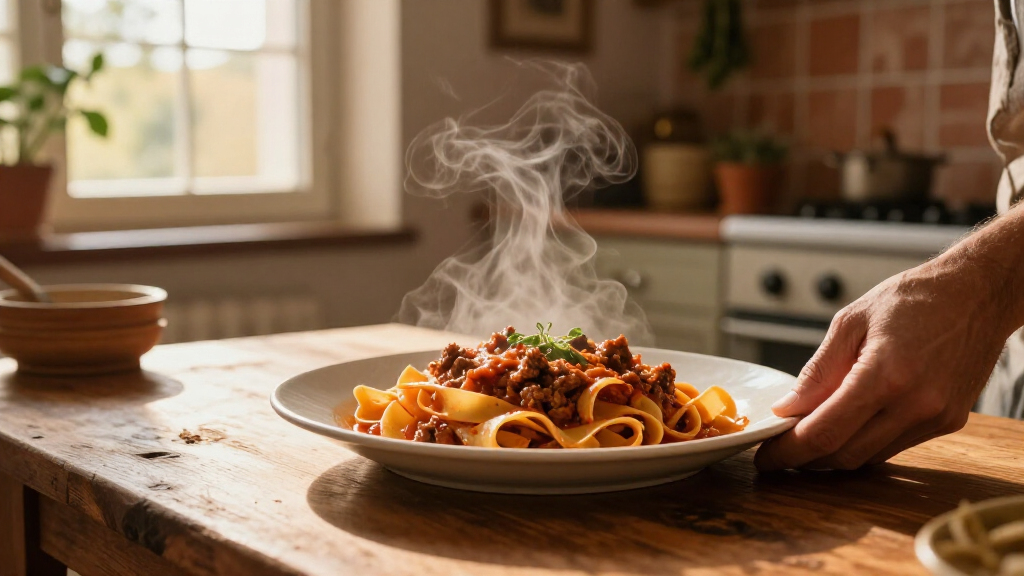
Bologna’s signature dish is a slow-simmered, meat-heavy ragù served over broad egg pasta ribbons — not the tomato-drenched spaghetti “Bolognese” found abroad. In 2023, the Italian Academy of Cuisine registered the authentic recipe with Bologna’s Chamber of Commerce to defend it.
What’s Actually in the Pan
The registered recipe defines ragù alla bolognese as a loose, spoonable meat stew — built slowly, with tomato in a supporting role only.
Pancetta & Soffritto
Rendered pancetta forms the fat base. Onion, carrot, and celery are softened gently — never browned — to build the aromatic backbone.
Coarsely Ground Beef
Browned to develop deep flavor, the beef dominates the sauce. Wine, and often milk or broth, enrich and balance the long simmer.
Fresh Egg Tagliatelle
Broad, porous ribbons designed to hold the dense ragù. Thin spaghetti can’t carry the weight — which is why Bologna never pairs the two.
Four Gentle Steps, Hours of Patience
Render the Pancetta
Slowly melt the pancetta to release its fat, creating the cooking base.
Soften the Soffritto
Onion, carrot, celery — cooked gently without browning.
Brown the Beef
Coarsely ground beef, browned to develop its full flavor.
Simmer 2–4 Hours
Wine, a touch of tomato, milk or broth — reduced to a spoonable stew.
“The sauce should resemble a loose, spoonable meat stew — not a tomato-heavy sauce.”
Authentic Ragù vs. Spaghetti “Bolognese”
| Attribute | Tagliatelle al Ragù | Spaghetti Bolognese (Abroad) |
|---|---|---|
| Sauce base | ✓ Meat-dominant | ✗ Tomato-forward |
| Tomato quantity | ✓ Small amount, for acidity | ✗ Heavy, sauce-defining |
| Cooking time | ✓ 2–4 hours | ~ Often quick-cooked |
| Pasta shape | ✓ Broad egg ribbons (~8 mm) | ✗ Thin spaghetti — poor sauce hold |
| Key meats | ✓ Pancetta + coarsely ground beef | ~ Varies, often simplified |
| Official recognition | ✓ Registered, Chamber of Commerce 2023 | ✗ No standard or protection |
Meat Leads, Tomato Supports
Relative prominence of each element in the authentic registered ragù.
Preserving a Culinary Identity
Before 2023, no formal standard existed for true tagliatelle al ragù — opening the door to widespread misrepresentation. The registration protects Bologna’s gastronomic reputation, supports local producers and artisans, and gives chefs and home cooks a benchmark for authenticity.
What ingredients are essential?
Fresh egg tagliatelle, pancetta, soffritto of onion, carrot, and celery, coarsely ground beef, a small amount of tomato, and wine. Milk or broth may enrich the sauce.
Why register the recipe in 2023?
To preserve Bologna’s culinary identity, combat international misrepresentations, and set a standard for authentic preparation.
Will restaurants abroad follow it?
It remains to be seen. Many establishments outside Bologna will keep serving their own versions due to local tastes and ingredient availability.
Can home cooks make it authentically?
Yes — following the detailed steps with quality ingredients yields a dish closely matching the recipe recognized by Bologna’s culinary authorities.
The Road Ahead for Culinary Preservation
Culinary events, educational programs, and collaborations with local chefs to promote awareness of the official recipe.
Possible certification or branding initiatives to distinguish authentic Bologna-style pasta dishes.
Official guidelines for restaurants and home cooks, plus potential legal protections for the recipe’s authenticity.
Whether other regional ragù variations will receive similar official recognition in Italy or abroad.
Why Bologna’s Traditional Ragù Matters
The registration of the official recipe in 2023 affirms Bologna’s culinary heritage and clarifies what authentic tagliatelle al ragù entails. It helps preserve a regional identity that has been misunderstood internationally, where spaghetti Bolognese is often served as a tomato-heavy, quick-cooked dish. For Bologna, this move protects its gastronomic reputation and educates both locals and visitors about the importance of proper ingredients, techniques, and pasta pairing.
Moreover, the official recipe supports local producers and artisans who craft traditional pasta and ingredients, bolstering the region’s economy and culinary tourism. It also provides a standard for chefs and home cooks aiming to replicate the authentic dish, ensuring the preservation of a centuries-old culinary tradition.
As an affiliate, we earn on qualifying purchases.
Historical and Cultural Background of Bologna’s Ragù
Bologna has a long-standing culinary tradition rooted in slow, careful preparation and regional ingredients. The dish of tagliatelle al ragù is closely tied to the city’s identity, with its origins dating back centuries. Historically, the dish developed as a way to utilize local meats and ingredients, emphasizing patience and technique over quick fixes. The pasta shape—broad, egg-rich ribbons—was chosen specifically to hold the dense, meat-based sauce, a concept that has persisted into modern times.
Over the years, international versions of ‘Bolognese’ have proliferated, often simplifying or altering the recipe, especially outside Italy. These adaptations tend to favor quick cooking, minimal ingredients, and a tomato-centric sauce, diverging from the traditional method. The recent registration of the official recipe aims to reaffirm Bologna’s authentic culinary heritage amid these variations.
Prior to 2023, there was no formal recognition or standardization of what constitutes true tagliatelle al ragù, leading to widespread misrepresentation. The move by the Italian Academy of Cuisine marks a significant step toward safeguarding regional food identities.
Remaining Questions About the Official Recipe
While the recipe has been officially registered, it is not yet clear how strictly restaurants and home cooks will adhere to these standards. There may be variations based on local ingredients, personal preferences, or evolving culinary practices. Additionally, how this recognition will influence international perceptions and menus remains to be seen, as many establishments outside Bologna continue to serve their own versions of ‘Bolognese.’
It is also uncertain whether other regional variations of ragù will receive similar official recognition or protections in Italy or abroad.
Next Steps for Culinary Preservation and Education
The Bologna Chamber of Commerce and the Italian Academy of Cuisine plan to promote awareness of the official recipe through culinary events, educational programs, and collaborations with local chefs. They may also develop certification or branding initiatives to distinguish authentic Bologna-style pasta dishes.
In the broader culinary community, there may be increased efforts to educate consumers and chefs about regional authenticity, potentially leading to more widespread adoption of the traditional preparation methods. Future developments could include official guidelines for restaurants and home cooks, along with possible legal protections for the recipe’s authenticity.
Key Questions
What ingredients are essential for authentic tagliatelle al ragù?
The essential ingredients include fresh egg pasta (tagliatelle), pancetta, a soffritto of onion, carrot, and celery, coarsely ground beef, a small amount of tomato, and wine. Milk or broth may also be used to enrich the sauce.
How does authentic Bologna ragù differ from spaghetti Bolognese?
Authentic Bologna ragù is a meat-dominant sauce with minimal tomato, slow-cooked for hours, served with broad, fresh egg pasta ribbons. Spaghetti Bolognese, by contrast, is typically tomato-heavy, quicker to prepare, and served with thin spaghetti, which does not hold the dense sauce well.
Why was the official recipe registered in 2023?
The registration aimed to preserve Bologna’s culinary identity, combat international misrepresentations, and provide a standard for authentic preparation of tagliatelle al ragù.
Will restaurants outside Bologna follow the official recipe?
It remains to be seen. While some may adopt the standard, many establishments outside Bologna will continue to serve their own versions, especially due to local tastes and ingredient availability.
Can home cooks make authentic tagliatelle al ragù?
Yes, by following the detailed steps and using quality ingredients, home cooks can prepare a dish that closely resembles the traditional recipe recognized by Bologna’s culinary authorities.
Source: Mad Tasting
Halloween Picks
halloween
As an affiliate, we earn on qualifying purchases.