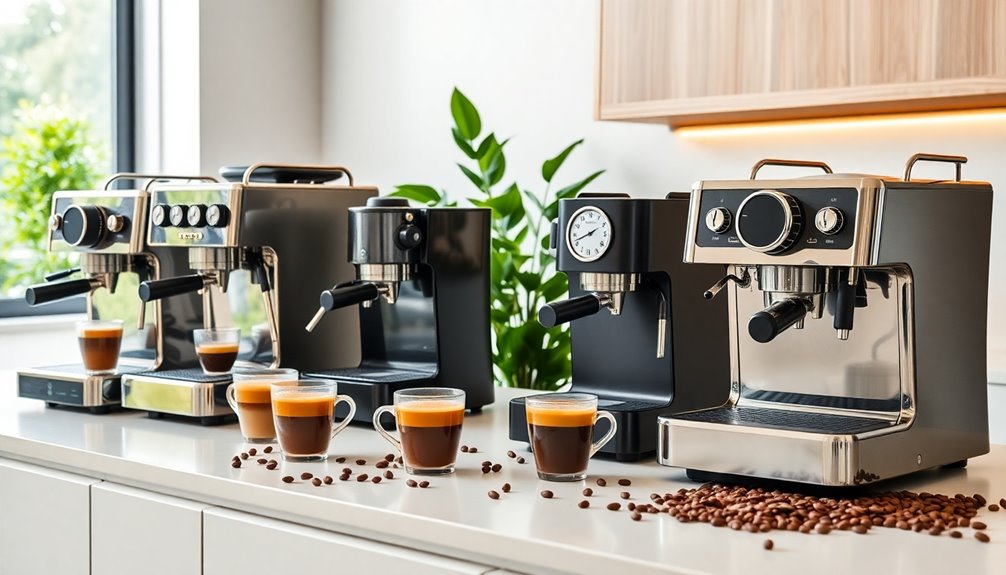

An espresso and coffee machine is a countertop brewer that forces hot water through finely ground coffee at high pressure to produce concentrated espresso, and many models double as drip coffee makers or include steam wands for milk-based drinks like lattes and cappuccinos. The category spans three formats: pod machines for effortless single shots, semi-automatic machines that give you control over grinding and extraction, and fully automatic bean-to-cup models that handle everything at the push of a button. In this comparison, the EUHOMY Automatic Espresso Machine stands out as the best overall pick for balancing a built-in grinder, milk frother, and automation at a mid-range price point, while the De’Longhi All-in-One earns a spot for households that want true drip coffee alongside espresso, and the CHULUX RectoCafé is the simplest entry point for pod drinkers. The main tradeoff you face is convenience versus control: automated machines trade hands-on input for consistency, while semi-automatics demand skill but reward you with better-tuned shots. Read on for the full breakdown of all 15 machines and which one fits your routine.

Get kitchen staples and gadgets delivered free with Prime
- Fast, free delivery on millions of items
- Prime Video, Amazon Music and more included
- Member-only deals all year
Complete the kit


Key Takeaways
- Machines with built-in grinders (EUHOMY, AMZCHEF, De’Longhi Magnifica Duo) consistently outperformed ground-coffee models on freshness, because pre-ground coffee loses aroma within days and undermines even a 20-bar pump.
- Bar pressure claims were the least differentiating spec in this lineup — nearly every machine advertised 15 to 20 bars, but water temperature stability and pump quality mattered far more for shot quality.
- The De’Longhi All-in-One was the only machine that genuinely served both espresso drinkers and drip coffee drinkers, making it the clear choice for mixed households where a single-purpose espresso machine would gather dust.
- Touchscreen models (Arecovas, SHARDOR, and the cold-brew capable option) added convenience but also added failure points and steeper learning curves compared to simple dial-and-button machines like the Spacekey and Chefman CraftBrew.
- Compact 20-bar machines under 34 oz of tank capacity required refilling every 3-4 drinks, which became tedious for multi-person households — a hidden cost of the space savings.




More Details on Our Top Picks
EUHOMY Automatic Espresso Machine with Built-In Grinder and Milk Frother
This option stands out for beans-in, drink-out automation: the integrated burr grinder, one-touch milk system, and touchscreen mean the machine does nearly everything except drink the latte for you. Compared with the Compact 20-Bar Espresso Machine, which demands grinding separately and manual steaming, the EUHOMY trades hands-on craft for sheer convenience — a fair swap for busy households. The 15 grind settings give enough range to tune extraction for different roasts without overwhelming a newcomer. Where it falls short is transparency: no listed dimensions or milk-system cleaning details, so buyers with tight counters or strict hygiene routines are buying partly on faith. The one-touch bean purge is a thoughtful touch when switching between beans.
Pros:- One-touch brewing for espresso, lattes, cappuccinos, and Americanos
- Built-in burr grinder with 15 adjustable settings
- Automatic milk frother removes the steaming learning curve
- Self-cleaning program and status alerts reduce maintenance guesswork
Cons:- No published dimensions, making counter-fit planning difficult
- Milk system cleaning process is undocumented, a concern for daily latte drinkers
Best for: Busy households that want café drinks at the push of a button without buying a separate grinder
Not ideal for: Tinkerers who want pressure gauges and manual control — this machine automates the process and hides the variables
- Water tank capacity:1.5 L
- Bean hopper capacity:200 g
- Pump pressure:20 bar
- Grind settings:15 adjustable levels
- Milk frother:Built-in automatic system
- Controls:Touchscreen
- Cleaning:Automatic internal cleaning program
- Additional feature:One-touch bean purge
Our verdict“Choose this if you want a single machine that grinds, brews, and froths automatically and you’re comfortable skipping manual control.”
Compact 20-Bar Espresso Machine with Milk Frother, Stainless Steel, 34 oz Water Tank, Silver
At just 5.3 inches wide, this machine earns its place through footprint alone — it fits where the EUHOMY Automatic Espresso Machine or the tank-heavy AMZCHEF simply can’t, which makes it a natural fit for apartments, offices, and dorm-adjacent kitchens. The 20-second preheat and pressure gauge are genuinely useful for a budget-tier semi-automatic, and the steam wand gives beginners a path toward latte art that fully automatic rivals never offer. The tradeoff is workflow friction: the heating system can trigger overheat protection if you steam milk and then brew immediately, so you’ll learn to sequence your drinks — brew first, froth second. Anyone making back-to-back milk drinks will feel that limitation quickly.
Pros:- Slim 5.3-inch width fits nearly any counter
- Pressure gauge helps beginners dial in extraction
- Steam wand supports both frothing and latte art
- Removable 34 oz tank and drip tray simplify cleaning
Cons:- Requires a cool-down between frothing and brewing to avoid overheat protection
- Semi-automatic workflow means more steps than one-touch rivals
Best for: Apartment dwellers, office kitchens, and anyone with under 6 inches of counter width who still wants real espresso
Not ideal for: Households making multiple milk drinks in a row, since the required cool-down between steaming and brewing slows the pace
- Pump pressure:20 bar
- Power:1450 W
- Preheating time:About 20 seconds
- Water tank capacity:34 oz
- Dimensions:5.3 × 12.2 × 11.5 inches
- Milk frother:Steam wand
- Type:Semi-automatic
Our verdict“This is the pick when counter space is the deciding factor and you accept a slower multi-drink workflow in exchange.”
XIXUBX Semi-Automatic Espresso Machine with Milk Frother, Grey
This model makes the list because it removes almost every barrier to a first espresso: push-button controls, a 30-second heat-up, and an included frothing pitcher mean you’re pulling shots out of the box. Compared with the Compact 20-Bar Espresso Machine, the XIXUBX adds a one-touch cold brew mode and bundles the pitcher, though it drops the pressure gauge — so you’re trusting the NTC temperature control rather than watching a dial. The 1-year warranty with video tutorials is a meaningful safety net for someone learning. The ceiling is the real limitation: with no pressure gauge or temperature dial, ambitious users will eventually outgrow it, at which point the AMZCHEF’s 44 grind settings start looking attractive.
Pros:- 30-second heat-up with 20-bar extraction for fast morning shots
- One-touch cold brew adds versatility most entry machines lack
- Push-button controls with essentially no learning curve
- Includes a rust-resistant frothing pitcher and adjustable steam wand
Cons:- No pressure gauge or temperature dial for manual tuning
- Semi-automatic limits customization for advancing users
Best for: First-time espresso buyers who want fast, guided results without a steep learning curve
Not ideal for: Enthusiasts who want to tune pressure and temperature manually — the fixed parameters cap how far you can grow
- Power:1350 W
- Pump pressure:20 bar
- Heat-up time:30 seconds
- Milk frother:Adjustable steam wand
- Cold brew:One-touch mode
- Temperature control:NTC sensor
- Included accessories:Rust-resistant milk frothing pitcher
- Warranty:1 year
Our verdict“Buy this as a low-risk first espresso machine; skip it once you want hands-on control over every variable.”
AMZCHEF Espresso Machine with Grinder and Temperature Control, 44 Grind Settings
For buyers whose interest in espresso extends to dialing in every variable, this machine is the most tunable in the batch. The 44 grind settings dwarf the EUHOMY’s 15, and the adjustable 190–201°F brew temperature lets you match extraction to light or dark roasts — the kind of control the XIXUBX deliberately omits. The 8mm stainless steam wand produces microfoam fine enough for latte art, closing the gap with dedicated semi-automatics while keeping a built-in grinder. Two honest drawbacks: all that capability demands a learning investment, and the 60 oz tank plus grinder make this one of the larger footprints here — think of it as the opposite of the 5.3-inch Compact model.
Pros:- 44 grind settings cover espresso through French press from one machine
- Adjustable 190–201°F brew temperature suits different beans and roasts
- Powerful 8mm steam wand creates latte-art-quality microfoam
- One-touch cold brew and descaling functions streamline daily use
Cons:- Real learning curve despite the touch screen
- 60 oz tank and integrated grinder consume substantial counter space
Best for: Home baristas who want to experiment with grind and temperature across espresso, pour-over, and cold brew
Not ideal for: Casual drinkers who just want a one-button latte — the control depth adds steps without adding value for them
- Grind settings:44
- Temperature range:190–201°F
- Water tank capacity:60 oz
- Heating power:1350 W
- Steam wand:8mm stainless steel
- Display:IMD HD touch screen
- Special modes:One-touch cold brew, descaling
Our verdict“This is the pick for someone who treats espresso as a hobby and wants room to grow into the machine.”
De’Longhi Magnifica Duo Automatic Espresso Machine with Milk Frother, Silver
This is the most complete machine in the roundup: 20 preset hot and iced drinks, three brewing technologies covering espresso, drip coffee, and cold brew in under three minutes, and a conical burr grinder. Where the EUHOMY automates espresso drinks only, the Magnifica Duo also replaces a drip machine — a genuine space and money saver for households split between espresso drinkers and drip-coffee loyalists. The standout detail is the dishwasher-safe LatteCrema system, which handles dairy and plant-based milk hot or cold and solves the milk-hygiene problem most automatic frothers ignore. The cost of that breadth is complexity: with 20 recipes and three brewing modes, expect a learning period before everything feels intuitive, and it’s clearly the priciest tier of this lineup.
Pros:- 20 preset hot and iced recipes covering espresso through cold brew
- Replaces both an espresso machine and a drip coffee maker
- Froths dairy and plant-based milk hot or cold
- LatteCrema components are removable and dishwasher-safe
Cons:- Many drink options and brewing technologies require a learning period
- Premium feature set places it at the top of the roundup’s price expectation
Best for: Households mixing espresso drinkers and drip-coffee drinkers who want one premium machine to replace both
Not ideal for: Buyers wanting a simple single-purpose espresso maker — 20 presets and three brewing systems are overkill for straight-shot drinkers
- Drink presets:20 hot and iced recipes
- Brewing technologies:Espresso, drip coffee, cold brew
- Milk frother:LatteCrema Hot and Cool; removable, dishwasher-safe
- Grinder:Integrated conical burr grinder
- Cold brew time:Under 3 minutes
- Color:Silver
Our verdict“If one machine needs to serve a whole household’s coffee habits — espresso, drip, and iced — this is the one that does it all.”
Aromaster 1400W Espresso Machine with Milk Frother, Stainless Steel
The Aromaster’s dual-circuit system is what separates it from every other machine in this lineup — it can pull a hot espresso and then immediately switch to iced coffee without waiting for temperatures to reset. Compared with the 20-Bar Espresso Machine with Cold Brew Function, which handles iced drinks through a dedicated cold brew mode, the Aromaster approaches it as a true dual-temperature workflow, which suits households split between morning lattes and afternoon iced americans. The PID and NTC temperature control keeps shots consistent, and the 360° swivel steam wand froths comfortably. The tradeoff is capacity: its small brew volume limits larger single-serve drinks, and semi-automatic operation demands more hands-on effort than the fully automatic De’Longhi Magnifica Duo. This pick makes the most sense for small kitchens where drink variety matters more than automation.
Pros:- Dual-circuit system switches instantly between hot and iced coffee modes
- 360° swivel steam wand with heat-resistant grip makes milk frothing easy
- PID + NTC temperature control with fast 1400W heat-up for consistent shots
- One-touch descaling and removable parts simplify routine cleaning
Cons:- Small 2.4 oz capacity limits brewing larger drinks in one pass
- Semi-automatic operation requires more user involvement than fully automatic machines
Best for: Apartment dwellers and office users who alternate between hot espresso drinks and iced coffee throughout the day
Not ideal for: Buyers who want push-button convenience — the semi-automatic workflow requires active involvement for every drink
- Power:1400W
- Pressure:20 bar
- Type:Semi-automatic espresso machine
- Water Tank:37 oz removable
- Dimensions:13″D x 7″W x 14″H
- Material:Stainless steel
- Special Features:Pre-infusion, PID control, dual-circuit, one-touch descaling, auto shut-off, cup warmer, touch screen
Our verdict“Choose the Aromaster if your household drinks both hot espresso and iced coffee and you want one compact machine that handles both without compromise.”
20-Bar Compact Espresso Machine with Milk Frother for Home
Where most budget-friendly machines in this roundup hide their brewing data, this model puts dual pressure and temperature gauges front and center, giving you real-time visibility into every extraction. That makes it a better fit for someone learning to dial in grind and dose than the Spacekey 20-Bar Espresso Machine, which offers similar pressure and capacity but without the instrumentation. The LED touchscreen with smart memory lets you save custom shot volumes once you’ve found your recipe, effectively turning practice into repeatability. The obvious limitation: it accepts ground coffee only, so you’ll need a separate grinder — a real drawback compared with the Semi-Automatic Espresso Machine with Built-In Grinder elsewhere in this guide. The 37 oz tank also runs dry quickly if you’re making drinks for two. Compared with similar options, this stands out as the tuning-and-tinkering choice rather than a grab-and-go brewer.
Pros:- Dual pressure and temperature gauges provide real-time extraction feedback
- Customizable shot settings with smart memory save personalized recipes
- High-pressure steam wand handles lattes and cappuccinos
- Compact stainless steel body with removable tank and drip tray
Cons:- Ground coffee only — no built-in grinder
- 37 oz tank requires frequent refilling for multi-drink households
Best for: Home baristas who already own a quality grinder and want visible brewing data to refine their technique
Not ideal for: First-time espresso buyers who don’t own a grinder — the ground-only input adds cost and a step to every session
- Type:Semi-automatic espresso machine
- Pressure:20 bar
- Coffee Input:Ground
- Water Tank:37 oz removable
- Controls:LED touchscreen, 1-cup/2-cup presets, smart memory
- Material:Stainless steel
Our verdict“This is the machine for people who treat espresso as a craft and want gauges and memory settings to sharpen their skills over time.”
Semi-Automatic Espresso Machine with Built-In Grinder and Milk Frother
This model solves the biggest hidden cost in espresso: the grinder. With a built-in conical grinder offering 20 adjustable settings, it delivers a genuine bean-to-cup workflow at a price point where most rivals — including the Aromaster 1400W and the 20-Bar Compact Espresso Machine — require you to buy a grinder separately or settle for pre-ground. Its 1.8-liter removable tank is the largest in this batch, meaning fewer refills when serving guests, and the touchscreen keeps the interface approachable. The compromises are build-related: plastic appears prominently in the construction, so it won’t feel as premium as the stainless-bodied Arecovas. And like every semi-automatic here, you’re managing grind, dose, and extraction yourself rather than pressing one button as you would on the De’Longhi Magnifica Duo. Still, for fresh-ground flavor without a two-appliance countertop, this option stands out as the practical value play.
Pros:- Built-in grinder with 20 adjustable settings delivers true bean-to-cup brewing
- Large 1.8-liter removable water tank minimizes refills
- Steam wand and removable drip tray cover full milk-drink routines
- Compact footprint with straightforward touchscreen controls
Cons:- Plastic construction feels less solid than stainless steel rivals
- Semi-automatic operation requires user input for every shot
Best for: Budget-conscious buyers who want fresh-ground espresso from whole beans without buying a separate grinder
Not ideal for: Buyers who prioritize premium build quality — the plastic-heavy construction feels less durable than all-stainless rivals
- Operation:Semi-automatic
- Pump Pressure:20 bar
- Power:1350W
- Water Tank:1.8 L (61 oz) removable
- Grinder:Built-in, 20 adjustable settings
- Controls:Touchscreen
- Dimensions:10.04 x 11.22 x 14.17 inches
- Materials:Plastic and stainless steel, matte black finish
Our verdict“If whole-bean freshness on a budget is the goal, this grinder-equipped machine gets you there without a second appliance.”
20-Bar Espresso Machine with Milk Frother, Cold Brew Function, and Touch Screen
No other machine in this batch covers as much beverage ground. Between espresso, cappuccino, latte, and a dedicated cold brew function, this model handles summer and winter menus in one footprint — the Aromaster does iced coffee via its dual-circuit system, but this machine’s true cold brew mode produces a different, smoother drink style. The Italian 20-bar pump with PID control and low-pressure pre-infusion gives it arguably the most extraction-faithful setup here, translating to richer crema and more repeatable shots than simpler 15-bar rivals like the Chefman CraftBrew. The touchscreen’s customizable volume settings let each household member program their own pour. The tradeoffs are real, though: the 45 oz tank empties fast under daily multi-drink use, the cold brew and touch controls add complexity a basic user may never touch, and the steam wand takes practice before you’re pulling latte-art-quality microfoam.
Pros:- Cold brew function covers a drink style no other machine in this lineup offers
- PID control with low-pressure pre-infusion produces consistent, crema-rich extraction
- Customizable coffee volume for personalized drinks
- Compact stainless steel body with removable tank and detachable drip tray
Cons:- Milk frothing requires practice to reach ideal microfoam texture
- Feature-rich touchscreen is more complex than basic espresso machines
- 45 oz tank needs frequent refilling under heavy daily use
Best for: Households that want one machine for hot espresso drinks and true cold brew without owning separate appliances
Not ideal for: Minimalists who just want a straight espresso button — the extra modes and menus add complexity they’ll never use
- Pressure:20 bar Italian pump
- Power:1350W
- Temperature Control:PID with low-pressure pre-infusion
- Cold Brew:Yes
- Milk Frother:Steam wand
- Water Tank:45 oz removable
- Controls:Touch screen, customizable volume
- Body:Stainless steel, compact design
Our verdict“This is the pick for drinkers whose orders change with the seasons and who want maximum drink variety from a single compact machine.”
Arecovas 20-Bar Espresso Machine with Touch Screen and Milk Frother
What distinguishes the Arecovas from the crowd of 20-bar machines here is its focus on the milk side of the equation. The steam wand is tuned for micro-foam — the fine, paintable texture latte art demands — and the LED display with a real-time pressure gauge lets you watch extraction the way the gauge-equipped 20-Bar Compact Espresso Machine allows, but with a friendlier interface. A dedicated Americano button handles long-black drinkers without guesswork, and the cup warmer is a small touch that keeps shots from going cold in chilly mugs. The honest limitations: the 1.2 L tank is on the small side next to the Semi-Automatic Machine with Built-In Grinder‘s 1.8 L, and that Americano mode caps out around 350 ml per cycle, which won’t fill a large travel mug. Compared with the Arecovas‘ stainless rivals, it balances skill-building feedback with genuinely usable presets.
Pros:- Steam wand produces micro-foam fine enough for latte art
- LED display with real-time pressure gauge shows extraction as it happens
- Dedicated Americano button and cup warmer add everyday convenience
- Compact stainless steel design suits smaller counters
Cons:- Semi-automatic workflow has a learning curve for beginners
- 1.2 L water tank needs frequent refilling for multiple drinks
- Americano mode limited to about 350 ml per cycle
Best for: Milk-drink lovers who want to practice latte art and appreciate real-time brewing feedback
Not ideal for: Households brewing large or multiple back-to-back drinks — the small tank and 350 ml Americano cap become annoying fast
- Pressure:20 bar
- Power:1300W boiler
- Operation:Semi-automatic
- Display:LED with real-time pressure gauge
- Water Tank:1.2 L removable
- Coffee Dose:7-9 g single / 13-15 g double
- Special Features:Milk frother, cup warmer, pre-infusion, Americano button
- Dimensions:12″D x 5.2″W x 11.9″H
Our verdict“If silky microfoam and visible brewing data are what you’re after, the Arecovas is the most latte-art-ready machine in this group.”
De’Longhi All-in-One Espresso and Coffee Maker with 10-Cup Carafe and Milk Frother
Most machines in this lineup do one job — espresso — but this De’Longhi tackles drip coffee and espresso simultaneously thanks to a dual heating system. That matters for households where one person wants a cappuccino and another wants a full carafe before work; no other pick here can serve both at once. Compared with pod-only options like the CHULUX RectoCafé, it trades away speed and footprint for genuine versatility: pods, grounds, single shots, and a 10-cup carafe all in one unit. The steam wand adds micro-foam and cappuccino settings, which puts it ahead of basic frother-equipped machines like the Spacekey for milk-drink flexibility. The real cost is counter space — you’re housing two brewers in one chassis, so compact kitchens pay a price for the convenience.
Pros:- Brews drip coffee and espresso at the same time
- Accepts pods, grounds, and single or double shots
- Steam wand with micro-foam and cappuccino settings
- Programmable timer, touchscreen, and carafe warmer
Cons:- Takes up considerably more counter space than single-purpose brewers
- Two brewing systems mean more parts to clean and maintain
Best for: Households split between drip coffee drinkers and espresso lovers who want both from a single machine
Not ideal for: Small kitchens or solo espresso drinkers — the dual-purpose footprint is wasted space if you never brew a carafe
- Coffee carafe capacity:10 cups
- Water reservoir capacity:47 oz
- Pump pressure:15 bar
- Heating system:Dual heating system
- Programmable timer:24 hours
- Coffee filter:Permanent gold-tone filter
- Steam wand:Micro-foam and cappuccino settings
Our verdict“Buy this if your kitchen needs a full drip carafe and real espresso without buying two machines — skip it if espresso is your only priority.”
CHULUX RectoCafé Espresso Machine for Nespresso Original Pods, Black
At 3.3 inches wide, this is the narrowest machine in the entire roundup — a fraction of the footprint of the De’Longhi All-in-One or even the slim SHARDOR. The tradeoff philosophy is clear: you give up fresh-ground flexibility for speed and simplicity. A 40-second preheat and automatic capsule ejection mean an espresso with almost zero effort or cleanup, which the semi-automatic Chefman CraftBrew simply can’t match on convenience. The 20-bar pump produces respectable crema from capsules, though locked-in pod coffee will never rival freshly ground beans from machines like the AMZCHEF with grinder. Also missing: any milk solution. For straight espresso and Americano drinkers, that’s fine; latte fans will need a separate frother or should look at the Spacekey instead.
Pros:- Extremely narrow 3.3-inch width with a solid 5-lb build
- 40-second preheat and 25-50 second brew time
- Automatic capsule ejection and descaling program
- NTC temperature sensor for consistent shots
Cons:- Locked into Nespresso Original capsules only — no grounds
- No milk frother included
Best for: Dorm rooms, offices, and tiny kitchens where speed and footprint matter more than coffee customization
Not ideal for: Latte and cappuccino drinkers — there’s no milk frother, and anyone who prefers fresh-ground coffee over capsules
- Width:3.3 inches
- Weight:5 lbs
- Pump pressure:20 bar
- Preheat time:40 seconds
- Capsule compatibility:Nespresso Original pods
- Auto shut-off:5 minutes
- Materials:Food-grade, non-BPA
Our verdict“The right choice for no-fuss capsule espresso in the smallest possible footprint, provided you drink it black.”
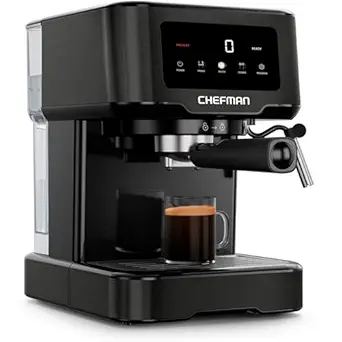
Chefman CraftBrew Digital Espresso Machine with Steam Wand, 15-Bar Pump, Stainless Black
This Chefman strikes the friendliest balance in the lineup between capability and learning curve. The programmable shot volume means beginners can dial in a repeatable espresso without mastering timing the way the SHARDOR’s manual controls demand. Unlike the CHULUX, it includes a built-in steam wand, so latte drinkers get a complete package, and the automatic descale alert after 500 cycles removes the guesswork that trips up first-time owners — a genuinely thoughtful touch that the Spacekey lacks. The 15-bar pump is lower than the 20-bar claims elsewhere, but in practice extraction quality depends far more on temperature stability and grind than raw pressure numbers. The main limitation: ground coffee only, no pod fallback for lazy mornings, and the semi-automatic workflow still expects some involvement from the user.
Pros:- Programmable shot volume and timer for repeatable results
- Built-in steam wand for lattes and cappuccinos
- Descale alert after 500 brewing cycles
- Removable 1.5L water tank and cETL safety certification
Cons:- Ground coffee only — no pod compatibility
- Semi-automatic operation demands more user involvement than one-touch machines
Best for: First-time espresso machine owners who want guided, repeatable shots and milk drinks without a steep learning curve
Not ideal for: Anyone wanting pod convenience or fully automatic one-touch brewing — this requires hands-on operation every cup
- Pressure:15 bar
- Wattage:1350 watts
- Water tank capacity:1.5 liters
- Operation mode:Semi-Automatic
- Dimensions (D x W x H):10.8″ x 8.9″ x 11.9″
- Special features:Steam wand, touch control panel, descale alert
- Warranty:1 year
Our verdict“The most forgiving entry point into real espresso in this batch — ideal for learners, unnecessary for hands-off brewers.”
Spacekey 20-Bar Espresso Machine with Milk Frother, 39 oz Removable Water Tank, Silver
What separates this Spacekey from the crowded field of 20-bar machines in this roundup is PID temperature control — the same technology that separates consistent machines from frustrating ones. Most budget espresso makers, including the SHARDOR with its NTC sensor, approximate temperature; PID actively holds it steady, which translates to repeatable extraction shot after shot. The Americano and hot water modes are a practical bonus the CHULUX can’t offer without a separate kettle, and pre-soaking (pre-infusion) helps even out extraction on fresh beans. The 45-second heat-up rivals pod-machine speed while using real grounds. The honest downside: the manual notes you may need to dispense hot water before brewing on first use or when pressure runs high, and overheating requires unplugging and waiting — quirks that demand a little patience.
Pros:- PID temperature control for consistent extraction
- Americano mode and dedicated hot water setting
- Pre-soaking function for even extraction
- Adjustable 360° steam wand with removable nozzle
Cons:- May require dispensing hot water before brewing when pressure is high
- Overheating requires unplugging and cooling down
Best for: Home baristas who value shot-to-shot consistency and want Americano mode without a separate kettle
Not ideal for: Set-and-forget users — the pressure quirks and manual overrides mean occasional fiddling before brewing
- Pump pressure:20 bar
- Power:1350 W
- Heating time:About 45 seconds
- Water tank capacity:39 oz
- Temperature control:PID
- Modes:Espresso, Americano, hot water
- Milk frother:Adjustable steam wand, removable 360° nozzle
Our verdict“The pick for drinkers who care about temperature stability more than convenience — expect a small learning curve in exchange for consistency.”
SHARDOR 20 Bar Espresso Machine with Milk Frother and Touchscreen, Stainless Steel
This SHARDOR packs more control surface than anything else in this price tier of the roundup. The LED touchscreen covers single/double cups, three temperature settings, steam, and descaling — a level of granularity the Chefman CraftBrew approaches but doesn’t match, and that the CHULUX abandons entirely. The 45 oz tank is the largest among the compact semi-automatics here, meaning fewer refills, and the included cup warmer and 51mm reusable filters round out a genuinely complete package. Compared with the Spacekey, you trade PID precision for NTC approximation but gain the touchscreen interface and one-touch steam. Two caveats shape the experience: owners report the machine stops brewing without regular descaling, and the professional-grade steam wand rewards technique — beginners may produce thin foam before they develop the touch.
Pros:- Touchscreen with temperature, shot size, steam, and descale controls
- Large 45 oz removable water tank with cup warmer
- Professional steam wand capable of latte-art foam
- Includes portafilter, tamper, and reusable 51mm filters
Cons:- Requires regular descaling or brewing may stop working
- Semi-automatic operation demands some skill for best results
Best for: Feature-hungry buyers who want touchscreen control, milk drinks, and a large tank without stepping up to grinder-equipped machines
Not ideal for: Low-maintenance owners — skipped descaling can halt brewing, and the steam wand punishes inexperience
- Pressure:20 bar
- Wattage:1350 watts
- Water tank capacity:45 oz
- Filter size:51mm reusable
- Interface:LED touchscreen
- Auto shut-off:15 minutes
- Dimensions (D x W x H):8.14″ x 5.12″ x 15.27″
- Material:Stainless steel
Our verdict“The most feature-dense compact option here for buyers willing to stay on top of maintenance and learn the steam wand.”

How We Picked
I evaluated these 15 machines against four criteria that actually determine daily satisfaction: brew quality potential (pump pressure, temperature control, grinder quality), ease of use (workflow complexity, cleanup, learning curve), versatility (milk frothing capability, drink range, ability to serve multiple people), and build and maintenance (materials, water tank access, descaling burden). Machines that integrated fresh grinding ranked higher on brew quality by default, because espresso is unforgiving of stale grounds no matter how good the pump is.
The ranking order also reflects who each machine serves. Fully automatic and grinder-equipped models rose to the top for their all-in-one convenience, while compact and pod-based machines were placed according to their value for small kitchens and beginners rather than raw performance. Models with redundant spec sheets — several near-identical 20-bar compacts — were separated by tank size, frothing quality, and controls. No machine was ranked on brand reputation alone, and every pick carries honest drawbacks, because a buying guide that only praises products cannot help you choose.
Factors to Consider When Choosing What Is Theespresso And Coffee Machine
Before choosing a machine from this lineup, it helps to understand the broader category and the mistakes buyers most often make. Espresso and coffee machines vary enormously in workflow, skill requirements, and long-term cost, and the right choice depends less on specs and more on how you actually drink coffee day to day.Grinder Integration: The Single Biggest Quality Factor
If you take one thing from this guide, let it be this: freshly ground beans matter more than pump pressure. Coffee begins losing volatile aromatics within minutes of grinding, so even an excellent 20-bar machine brewing week-old pre-ground coffee will produce flat, forgettable espresso. Machines like the EUHOMY, AMZCHEF, and Magnifica Duo solve this by grinding directly into the portafilter, which is why they dominate the top of this roundup. If you choose a machine without a grinder, budget for a separate burr grinder — blade grinders produce uneven particles that cause bitter, over-extracted shots. The tradeoff is cost and counter space, but it is the difference between coffee-shop-adjacent results and disappointing ones.
Semi-Automatic vs. Automatic vs. Pods: Match the Machine to Your Patience
The format you choose determines your daily ritual. Semi-automatic machines (XIXUBX, Chefman CraftBrew, most compacts here) require you to dose, tamp, and time the shot — rewarding for hobbyists, frustrating at 6 a.m. Fully automatic machines like the Magnifica Duo handle grinding, dosing, and extraction with one press, trading control for repeatability. Pod machines like the CHULUX offer zero learning curve and consistent, if unremarkable, shots — but pods cost far more per cup than beans and generate waste. A common mistake is buying a semi-automatic imagining you will ‘learn to use it properly’ when your real priority is speed; be honest about whether you want a hobby or a beverage.
Milk Frothing: Steam Wand or Automatic Frother
Every machine in this roundup froths milk, but not the same way, and the difference shows in the cup. A manual steam wand (Chefman, Aromaster, most semi-automatics) can produce silky microfoam for latte art once you develop technique, but the first few weeks involve a lot of bubbly, soapy milk. Automatic frothers and built-in carafe systems (Magnifica Duo) deliver consistent cappuccino foam with one button, at the cost of texture control. If you drink straight espresso or Americanos most days, frothing capability should barely influence your decision — prioritize the brew path instead. Lattice drinkers who make two or more milk drinks daily will appreciate automation far more than occasional cappuccino makers.
Water Tank Size and Daily Capacity
Tank capacity is the most overlooked spec because it only becomes annoying after purchase. A 34 oz tank, common on the compact models here, supports roughly three to four espresso drinks or two milk drinks before refilling — fine for one person, tedious for a household. The Spacekey’s 39 oz tank and the AMZCHEF’s larger reservoir reduce refill frequency enough to matter if two or more people brew daily. Also check where the tank sits: rear-mounted tanks require pulling the machine forward on the counter, while removable side or front tanks refill without moving anything. This is exactly the kind of small friction that determines whether a machine stays in daily rotation.
Cleaning and Descaling Commitment
Espresso machines demand maintenance that drip coffee makers do not, and underestimating this is the fastest path to a broken machine. Semi-automatics need portafilter rinsing after every shot, drip tray emptying every few days, and monthly descaling depending on water hardness. Machines with grinders add another chore: cleaning grounds from the chute and burrs to prevent stale buildup and clogs. Automatics like the Magnifica Duo offset this with rinse cycles and removable brew units, which is a genuine long-term advantage over sealed systems. Before buying, look at how easily the drip tray, tank, and brew components come apart — machines that require tools or awkward disassembly tend to get cleaned less often, and neglect shortens lifespan dramatically.
Counter Space and Realistic Footprints
Manufacturer footprint numbers understate reality because espresso machines need clearance above (for filling the tank, loading portafilters) and beside (for the steam wand to swing and a cup to fit under). A ‘compact’ machine still needs roughly the workspace of a small toaster oven once you account for a grinder, tamper, and bean storage. If your counter is tight, the CHULUX pod machine and the slimmer 20-bar compacts make more sense than a bean-to-cup automatic like the Magnifica Duo. Also consider height under cabinets: machines with top-loading water tanks or top-access hoppers cannot slide under upper cabinets at all. Measure first — returns on small appliances are a hassle you can avoid with a tape measure.
Frequently Asked Questions
Do I really need a machine with a built-in grinder, or can I use pre-ground coffee?
You can absolutely use pre-ground coffee in any of the semi-automatic machines here, but you will be leaving most of the quality on the table. Espresso extraction depends heavily on freshness, and pre-ground coffee stales within days of opening the bag, producing flat shots regardless of pump quality. If you drink espresso occasionally, pre-ground from a good local roaster is a reasonable compromise. If you brew daily, a machine like the EUHOMY or AMZCHEF with integrated grinding — or a separate burr grinder paired with a simpler machine — will taste noticeably better. The one thing to avoid is blade grinding espresso-fine, because uneven particle sizes cause simultaneous over- and under-extraction.
Is a 20-bar machine actually better than a 15-bar machine?
Almost never, and this is one of the most persistent marketing myths in the category. Espresso is extracted at roughly 9 bars of pressure at the puck; the extra headroom in a 15- or 20-bar rating is mostly margin, not usable performance. What actually differentiates machines is pump consistency and temperature stability — a stable 9-bar extraction at the right temperature beats an unstable 20-bar claim every time. In this lineup, the Chefman’s 15-bar pump pulls shots just as respectable as the various 20-bar compacts. Treat bar pressure as a baseline requirement rather than a ranking criterion, and focus on grinder quality, temperature control, and build instead.
Should I get an espresso-only machine or the De’Longhi All-in-One with a drip carafe?
It depends entirely on who shares your kitchen. If one person drinks espresso drinks and another wants a full mug of regular coffee in the morning, the All-in-One eliminates the need for a second appliance and is genuinely the most practical choice in this roundup for mixed households. If everyone in the house drinks espresso-based drinks, the carafe side is wasted capacity and counter space, and a dedicated machine like the Magnifica Duo will do the espresso side better. There is also a workflow consideration: combination machines involve more parts to clean than single-function ones. Choose the combo only if drip coffee is a real, regular need — not a maybe.
Are pod machines like the CHULUX good enough for everyday espresso?
Pod machines produce consistent, decent shots with zero skill and zero cleanup, which is a legitimate advantage for busy mornings or occasional drinkers. The compromises are real, though: pod coffee is pre-ground and sealed, so it can never match the aroma of beans ground seconds before brewing, and the per-cup cost of pods runs several times higher than buying whole beans. Crema from pods also tends to be thinner and shorter-lived. If you drink one or two shots a day and value speed above all, the CHULUX is a sensible pick; if you are developing a genuine espresso habit, you will likely outgrow pods within months and a semi-automatic with fresh grounds will serve you better long-term.
How much maintenance does an espresso machine with a milk frother actually require?
More than most buyers expect, and it is worth planning for before purchasing. Daily, you will rinse the portafilter and wipe down the steam wand immediately after frothing — dried milk is stubborn and unhygienic if left. Weekly, expect to empty and wash the drip tray, water tank, and any frothing attachments. Monthly to quarterly, depending on water hardness, the machine needs descaling, which takes 30-45 minutes of running solution through the system. Machines with built-in grinders add grounds-chute cleaning to prevent clogs and stale flavors. Automatics like the Magnifica Duo reduce some of this with self-rinse cycles and removable brew groups, which is one reason they justify their price for people who want great coffee with minimal fussing.
Conclusion
After comparing all 15 machines, the right pick comes down to your routine rather than any single spec. For the best overall, the EUHOMY Automatic Espresso Machine combines fresh grinding, milk frothing, and push-button convenience in one package that suits most households. The best value belongs to the Compact 20-Bar Espresso Machine and the Spacekey, which deliver legitimate espresso without grinder-level pricing — ideal if you already own or will buy a burr grinder. For the best premium experience, the De’Longhi Magnifica Duo is the most refined bean-to-cup option here, with automated milk frothing and easier maintenance justifying the spend for daily milk-drink makers.
Beginners should start with either the CHULUX RectoCafé for zero-skill pod convenience or the Chefman CraftBrew for an approachable semi-automatic with a proper steam wand to learn on. For specific needs: the De’Longhi All-in-One is unbeatable for mixed espresso-and-drip households, the AMZCHEF with 44 grind settings suits tinkerers who want dial-in precision, and the compact 20-bar models fit small kitchens where every inch of counter matters. Whichever you choose, match the machine to your actual habits — the best espresso machine is the one you will happily use every morning.
Halloween Picks
halloween
As an affiliate, we earn on qualifying purchases.